



To steadily advance the implementation of the "Accounting + Law" joint bachelor’s degree program and ensure high-quality cultivation for the first cohort of students, on June 18, 2026, the School of Accounting at Dongbei University of Finance and Economics (DUFE) and the Law School of Dalian Maritime University (DMU) held a seminar on the construction of the joint bachelor’s degree program in Conference Room 233 of Quanxue Building. Attendees included Fen HUANG, Associate Dean of the Law School of DMU, and Yi LIN, Director of the Civil and Commercial Law Teaching and Research Office; from DUFE’s School of Accounting, participants included Kejing CHEN, Associate Dean; Yunyun JIN, Director of the Accounting Department; Shuqin SONG, Director of the Financial Management Department; Dongyan MO, Deputy Director of the Accounting Department; Liang XIAO, Director of the Financial Accounting Teaching and Research Office; and Xiaodong LIU, Teaching Secretary.
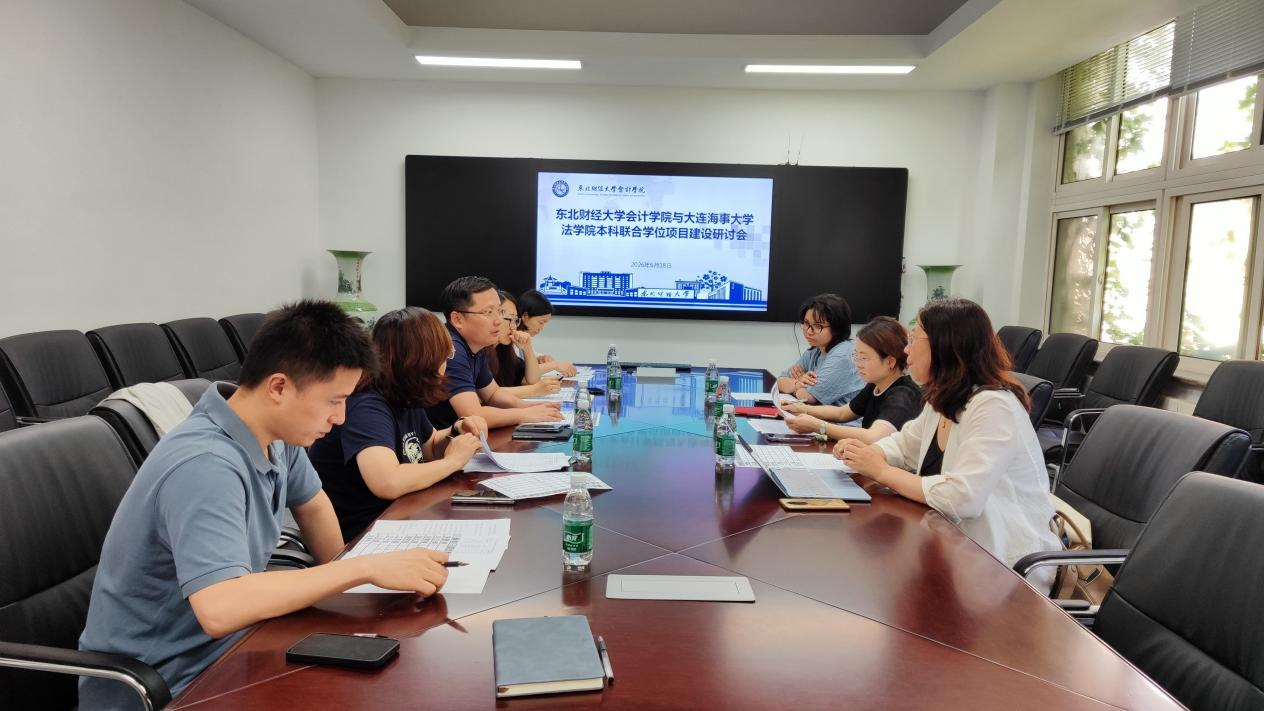
At the meeting, Kejing CHEN, on behalf of the School of Accounting, welcomed the delegation from the Law School of DMU. He noted that this seminar focused on the critical phase prior to student enrollment, discussing core tasks such as curriculum system development, cross-institutional teaching operations, and day-to-day academic management, with the goal of ensuring a smooth launch and high-quality operation of the joint degree program.
Fen HUANG introduced the progress of the program implementation at the Law School of DMU. She emphasized that the first cohort of joint students would serve as a demonstration model for the program. Both universities need to integrate their high-quality educational resources, strictly control talent cultivation quality, build a benchmark project for interdisciplinary joint cultivation, and set an example for cross-institutional cultivation of compound talents in finance, accounting, and rule of law.
Subsequently, the participants conducted in-depth discussions on four aspects: enrollment promotion, curriculum system optimization, cross-institutional teaching models, and long-term collaborative education mechanisms. Multiple consensuses were reached: the two universities will unify their promotional messaging, highlight disciplinary strengths and program advantages, and enhance the program’s appeal to prospective students; they will clarify and implement core course arrangements, share high-quality faculty, and improve the integrated curriculum system; they will respectively establish program expert groups, implement a dual-supervisor system, offer cutting-edge academic lectures, and deepen industry-education integration to build a long-term collaborative education mechanism; and they will streamline teaching management processes including cross-institutional teaching, course selection, and credit transfer.
Both sides unanimously agreed that they will concentrate superior teaching resources to ensure program quality, plan diverse cross-institutional academic and practical activities, and, starting with the cultivation of the first cohort, strive to build a distinctive, high-quality, and socially recognized interdisciplinary joint cultivation brand.