



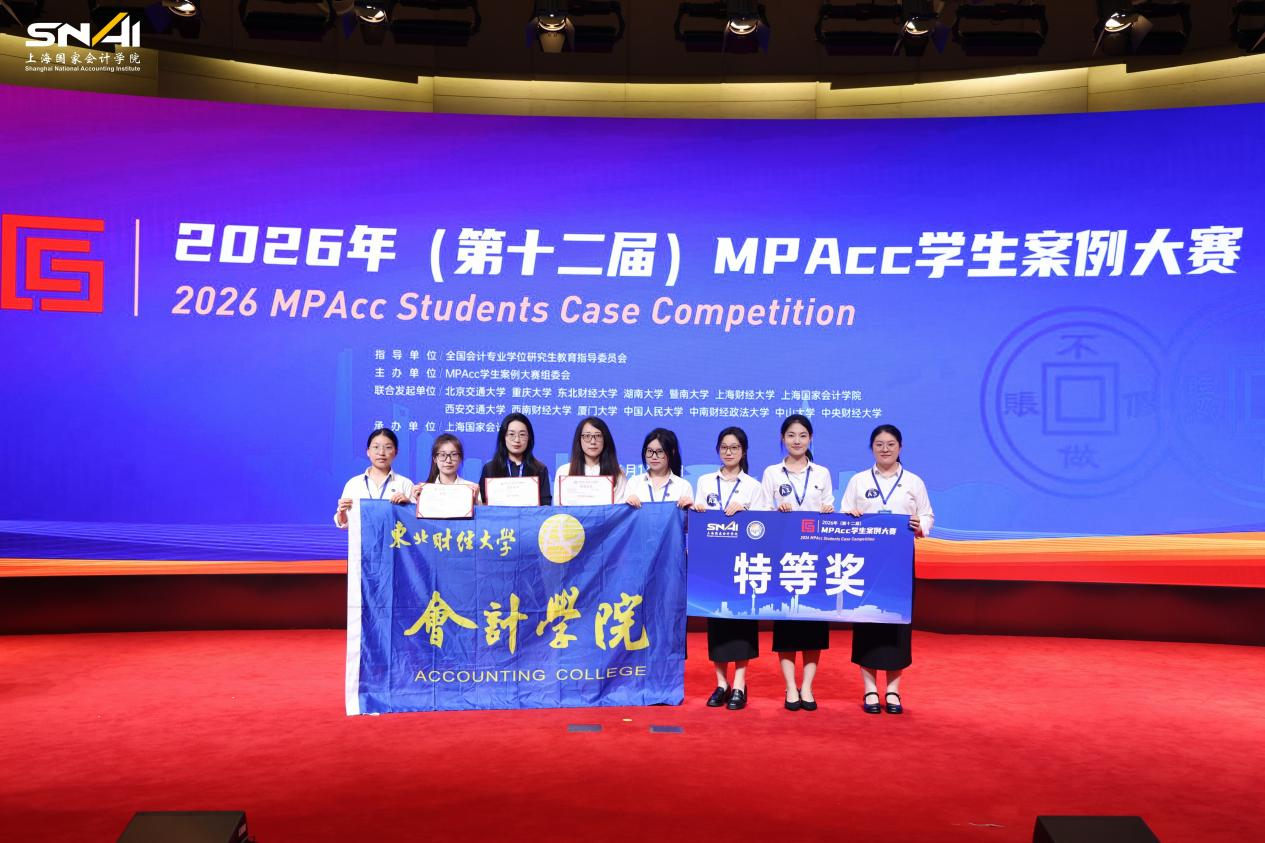
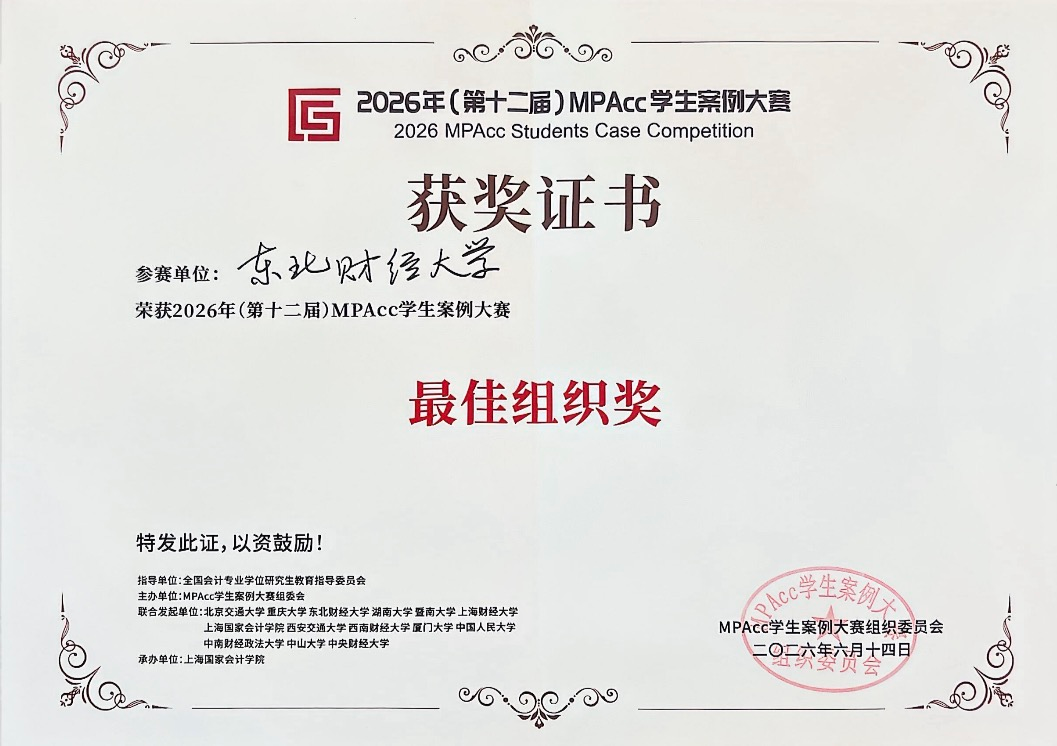
The semi‑finals and finals of the 2026 (12th) MPAcc Student Case Competition were successfully held on June 13‑14 at the Shanghai National Accounting Institute. The MPAcc team “Dawn Breakers” from the School of Accounting, Dongbei University of Finance and Economics (DUFE), authorised to represent the university, won the Grand Prize of the competition (supervised by Yunyun JIN and Fei QIAO; team leader: Boyu PAN; team members: Shimeng LIU, Xinyu CUI, Yaqi CHENG, Wanting BAI, and Xiaoya WANG). The supervisors Yunyun JIN and Fei QIAO received the “Excellent Supervisor Award”. Another MPAcc team “Born for First Prize” won the Third Prize (supervised by Yue YU and Fajing CUI; team leader: Xinyu NI; team members: Xuening BAI, Xuan LIU, Ruoxi LI, Yiwen YAN, and Xuming ZHAO). DUFE was also honoured with the “Best Organization Award”, setting a new record for our School in the history of this competition. To date, faculty and students of the School of Accounting have made it to the semi‑finals and finals of the competition a total of ten times, accumulating one Grand Prize, one First Prize, eight Second Prizes, five Third Prizes, and four Best Organization Awards. This makes the School one of the MPAcc programme providers in China with the most appearances in the semi‑finals and finals and the best average performance over the years.
The MPAcc Student Case Competition is a non‑profit event guided by the National Committee of Accounting Professional Degree Postgraduate Education and organized by the MPAcc Student Case Competition Organizing Committee. The competition covers seven major regions across China: Northeast, North China, East China, Central China, South China, Southwest, and Northwest. Having been successfully held for twelve consecutive years, it receives high attention from all MPAcc programme providers nationwide. The competition not only exerts extensive influence and guidance in the cultivation of accounting professionals, but also hones students’ comprehensive abilities to identify, analyse, and solve real‑world business problems, serving as a vital platform for demonstrating professional competence and supporting students’ growth and success.
This year, a total of 3,257 MPAcc teams and 345 undergraduate teams from across the country registered for the competition. Our MPAcc team “Dawn Breakers”, with solid theoretical expertise and excellent case analysis and writing skills, advanced through multiple rounds—including internal school selection, the first stage of the preliminary round, the second stage of the preliminary round, and collective review—to reach the national top ten and qualify for the semi‑finals and finals. From the head‑to‑head battles among the top ten teams in the semi‑finals to the three‑way confrontations and alternating offence‑and‑defence exchanges in the finals, the team members closely focused on the core issues of the case, presented clear and logical arguments, and responded calmly, demonstrating outstanding professional competence, adaptability, and teamwork. Ultimately, they claimed the highest honour of the competition.
The School of Accounting at DUFE has always attached great importance to the cultivation of professional master’s degree students. To achieve the distinct objectives of postgraduate education, the School places special emphasis on enhancing students’ practical abilities to analyse and solve problems under the guidance of theory. Using the case competition as a key entry point, the School has continuously established and improved incentive and support mechanisms, fostering a tradition of broad participation and building a professional master’s cultivation model that effectively links the entire training process with the competition. Leveraging its rich practical resources, the School provides participating students with various research and field‑visit opportunities, and after the competition, case reports are fed back to the investigated enterprises, thereby deepening industry‑education integration and steadily improving the quality of practical training bases. This championship victory is a clear manifestation of the School’s commitment to differentiated postgraduate training. Looking ahead, the School will continue to use the case competition as an educational vehicle—promoting learning through competition and empowering through research—while further deepening industry‑education integration and collaborative education, so as to continuously enhance the quality of talent development for professional master’s degree programmes.