



On May 10, 2026, the Accounting School successfully held the "Seminar on Building China's Independent Accounting Knowledge System" (also the 283 "DUFE Accounting & Finance Forum") in Room 246, Quanxue Building. Professor Donghua CHEN, Vice President of Nanjing Audit University, was invited as the keynote speaker. Professor CHEN delivered a special report titled "The Cultural Tradition Behind Accounting Research and Its Pursuits."
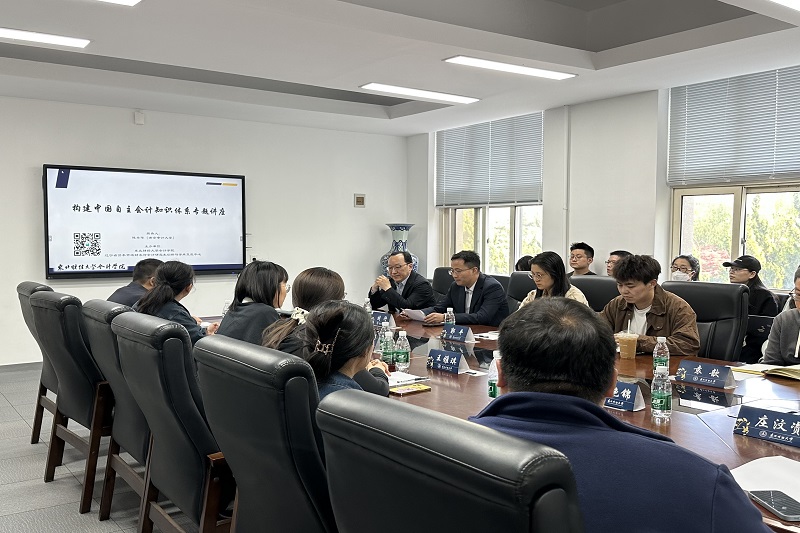
Starting from his own academic and research journey, Professor CHEN systematically explained why and how he deeply integrates traditional Chinese culture with accounting research. He pointed out that culture is the underlying conceptual system behind institutions, and that accounting is not a purely neutral "universal business language" but possesses distinct cultural attributes and historical field-specificity. Contemporary Chinese accounting research should be rooted in traditional Chinese culture and proceed from the continuity of Chinese civilization to build an independent Chinese accounting knowledge system.
Through an in-depth analysis of Pacioli's double-entry bookkeeping principle, Professor Chen revealed the implicit Western inclinations within it. He noted that debit-credit bookkeeping is not merely a recording technique; its core principle—that a person's total property equals the total value of that person's ownership—essentially reflects a Western cultural concept that attributes all profits and losses exclusively to shareholders. By contrast, he drew on a wide range of examples, from the ancient Chinese "four-column settlement method," the "partnership system" and "body-share system" of Shanxi draft banks, to contemporary practices of companies such as Pang Dong Lai, JD.com, and Huawei. These examples vividly illustrate how concepts in Chinese culture such as "restraining profit with righteousness," "righteousness before profit," and "unity of righteousness and profit" fundamentally shape economic activities and accounting thought. He emphasized that the differences between Chinese and Western accounting are rooted in their respective cultural traditions. Chinese accounting research should deeply inherit and promote the fine traditional Chinese culture, drive theoretical innovation while upholding fundamental principles, and cultivate genuine Chinese characteristics and style.
During the interactive session, Professor Chen engaged in thorough and lively discussions with faculty and students on topics such as how doctoral students can conduct normative research, the path to building a historical school of accounting, and how to incorporate cultural perspectives into specific research. He encouraged young scholars to approach Chinese culture with warmth and reverence, to combine reading with research, and to pursue scholarship that is grounded and soulful.
The forum concluded with warm applause from the audience. Professor Chen’s lecture was insightful and broad in vision, skillfully blending profound traditional cultural knowledge with cutting-edge accounting theory, offering a feast of ideas to all present. The successful hosting of this forum not only deepened the understanding of the essence of accounting among our faculty and students, prompting reflection on the fundamental value and social mission of accounting research, but also provided valuable theoretical perspectives and practical directions for building China's independent accounting knowledge system.